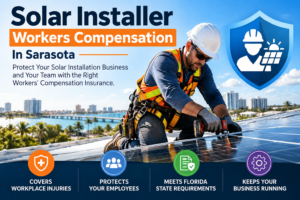

The solar energy industry is booming across the United States. As more homeowners and businesses switch to renewable energy, solar installation companies are busy scaling their operations. However, with growth comes increased risk. For a solar installation business, the greatest asset is the crew on the roof, and the greatest liability is their safety. This is why Workers Comp for Solar Installation Businesses is not just a legal requirement—it is the foundation of a sustainable business.
Operating a solar installation company involves unique hazards that general contractors do not always face. Roof work, heavy lifting, ladder use, and handling high-voltage equipment combine to create a high-risk environment. Without proper coverage, a single accident could financially cripple a thriving business.
Why Solar Installers Face Higher Risks
Unlike traditional office jobs, solar installation requires technicians to work at significant heights. The Occupational Safety and Health Administration (OSHA) frequently lists falls as a leading cause of fatalities in the construction industry. For solar workers, the risk of falling from a sloped or slippery roof is constant.
Additionally, installers are exposed to environmental hazards. Prolonged sun exposure can lead to heat exhaustion or heat stroke, which are valid workers’ compensation claims. Beyond the physical strain, there is the risk of electrical burns or shock from live wiring.
Understanding Workers’ Comp Requirements
Most states mandate Workers’ Compensation insurance for businesses with even one employee. If you are a sole proprietor, you may be exempt in some states, but as soon as you hire a helper, you generally need coverage.
The policy does two main things:
-
Covers medical expenses and a portion of lost wages for employees injured on the job.
-
Protects the employer from lawsuits filed by injured employees regarding workplace injuries.
For a solar installation business, the classification code used by insurance carriers significantly impacts the premium. Generally, solar installers are classified under a specific code for “Solar Panel Installation” or “Roofing” (depending on the state). Since the work is considered “construction,” the rates are higher than those for retail or clerical positions.
Why General Liability Isn’t Enough
Many new business owners confuse General Liability with Workers Compensation. General Liability covers damage you do to a customer’s property (e.g., dropping a tool on their car or a leak caused by a misplaced panel). It does not cover injuries to your employees.
If an employee falls off a roof and breaks a leg, General Liability will not pay the medical bills. Without Workers’ Comp, you are personally liable for that injury. Furthermore, in many states, failing to carry this insurance can result in hefty fines, stop-work orders, or even criminal charges.
Cost Factors for Solar Installers
The cost of your premium is determined by the classification code and your payroll. Typically, the rate is expressed as a dollar amount per $100 of payroll. For solar installation, the rate is often influenced by the height of the work and the safety record of the company.
To keep costs manageable, insurance providers look for:
-
Safety Training: Are your crews certified in OSHA standards?
-
Claims History: A clean record lowers your “Experience Modification Rate” (EMR).
-
Equipment Use: Are ladders and harnesses regularly inspected?
Mitigating Risks and Reducing Premiums
While you cannot eliminate the risk of accidents, you can reduce the frequency and severity.
1. Invest in Training: Ensure every team member is trained on proper lifting techniques and ladder safety. A few hours of training can prevent thousands of dollars in claims.
2. Use Proper Safety Gear: Harnesses, guardrails, and safety nets are non-negotiable. Providing the right equipment reduces the chance of severe injury during a fall.
3. Pre-Job Inspections: Walk the property before starting. Identify trip hazards, uneven terrain, and potential overhead power lines. Pre-planning the panel lift path can minimize risk significantly.
4. Heat Safety: Implement a hydration schedule and provide shaded rest areas to prevent heat-related illnesses.
5. Vehicle Safety: Many injuries occur during transit. Ensure vehicles are maintained, and drivers are well-rested.
The Employee Retention Angle
Offering Workers’ Comp is not just about compliance; it’s about employee morale. When technicians know that they are covered if something goes wrong, they feel valued. In a competitive labor market, providing comprehensive benefits, including Workers Compensation, helps you attract and retain skilled labor.