

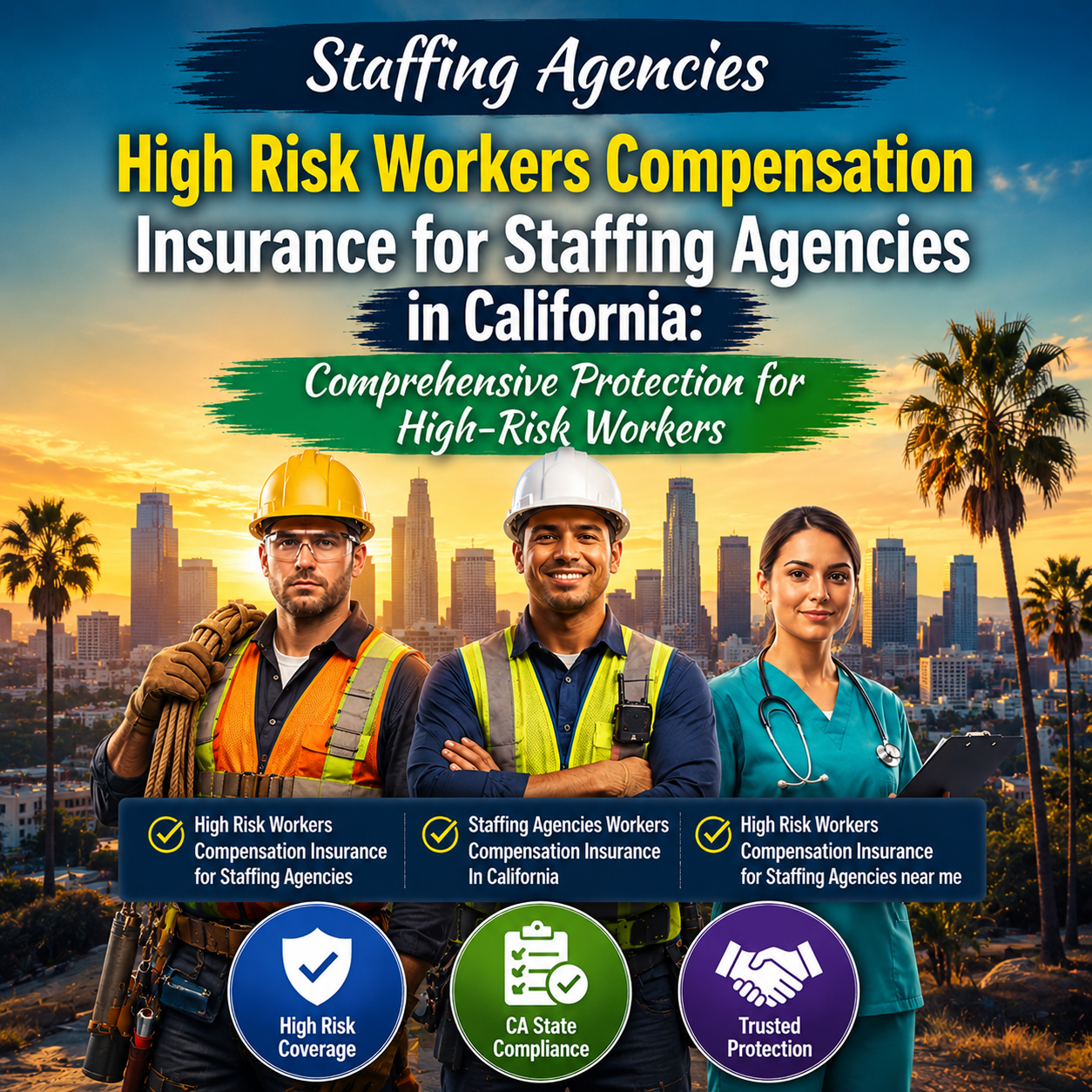
California’s staffing industry moves fast. One day, you’re placing administrative assistants. Next, you’re filling a warehouse order for light industrial workers or temp-to-hire construction laborers. That flexibility is your business’s strength—but it also makes you a high risk in the eyes of workers’ compensation insurers.
If you’ve searched for “High-Risk Workers Compensation Insurance for Staffing Agencies in New York” or “High Risk Workers Compensation Insurance for Staffing Agencies near me,” you already know the challenge: standard carriers often decline, quote astronomical premiums, or demand audits that leave you buried in surprises.
At Coastal Work Comp, we specialize in exactly this niche. Here’s what you need to know to protect your agency, your temps, and your bottom line.
Why Staffing Agencies Are Classified as “High Risk”
Insurance carriers categorize risk based on two things: job classification codes (class codes) and loss history. Staffing agencies face three unique vulnerabilities:
- Transient Workforce – Temps are new to your worksite every few days or weeks. They haven’t built muscle memory or safety habits for that specific environment.
- Varied Class Codes – One agency might place clerical workers (low-risk, class code 8810) alongside roofers (high-risk, class code 5037). Carriers struggle to price mixed exposures.
- No Direct Control Over Worksites – Your employee gets hurt on a client’s premises. The client’s safety culture—or lack thereof—directly impacts your claim frequency.
In California, where the average workers’ comp claim cost is already higher than in most states, carriers have become increasingly strict. That’s why searching for “high-risk workers’ compensation insurance for staffing agencies near me” often returns few local options.
The Legal Reality: California Labor Code Section 3700
California law requires every employer, including staffing agencies, to carry workers’ compensation insurance. Failure to comply leads to:
- Stop-work orders from the Division of Labor Standards Enforcement (DLSE)
- Fines up to $100,000 per violation
- Misdemeanor criminal charges in extreme cases
But here’s what many agency owners miss: temps are legally your employees, not the client’s. If a temp falls from a ladder at a client’s construction site, your workers’ comp policy pays—not the client’s. That’s why your coverage must be rock-solid.
Key Class Codes for Staffing Agencies in California
Your premium depends heavily on correct classification. Common codes include:
| Class Code | Description | Typical Rate Risk |
| 8810 | Clerical office employees | Low |
| 8742 | Salespeople outside/collectors | Low-Medium |
| 8227 | Light industrial – assembly, packaging | Medium |
| 8380 | Truck drivers – local | Medium-High |
| 5037 | Construction – roofing | High |
| 8018 | Warehouse – store employees | Medium |
A good carrier (like Coastal Work Comp) will help you audit your class codes annually to avoid both underpayment penalties and overpayment waste.
How to Lower Your Workers’ Comp Costs Despite High Risk
Just because you’re high risk doesn’t mean you’re doomed to crushing premiums. Here are six proven strategies:
1. Implement a 24-Hour Injury Reporting Protocol
Carriers reward speed. Train your on-site supervisors (and client contacts) to report any injury within 24 hours—even if it seems minor. A delayed report often escalates treatment costs.
2. Use Payroll-Based vs. Manual Rating
Some carriers offer a “payroll-based” rating for staffing agencies, where the premium adjusts weekly based on actual hours worked by class code. This prevents massive audit bills at year’s end.
3. Client Safety Vetting
Before placing a temp in a high-risk environment, request the client’s OSHA 300 log or safety records. Coastal Work Comp provides a simple client-safety checklist. Decline placements at client sites with high violation rates.
4. Return-to-Work (RTW) Program
California’s workers’ comp system incentivizes modified duty. For every dollar spent on a structured RTW program, agencies save $3–5 in claim costs. Even light-duty—like answering phones—stops temporary disability payments.
5. Experience Modification (X-Mod) Management
Your X-Mod compares your claim history to other agencies of similar size. A mod of 1.0 is average. Many staffing agencies run 1.2 to 1.5. But with loss control, you can reduce it. Coastal Work Comp offers free X-Mod reviews.
6. Bundle with Other Coverages
If you also need general liability or umbrella insurance, bundling can reduce administrative fees. Ask about multi-policy credits.
What Happens When You Can’t Find a Carrier?
The “near me” problem is real. Many local independent agents avoid high-risk staffing because they lack markets. When that happens, you have two options:
- The Assigned Risk Pool (WCIRB) – California’s pool of last resort. Coverage is expensive (often 25–50% higher than standard market), and you have no say in carrier selection.
- A Specialized Wholesale Broker – That’s where Coastal Work Comp steps in. We work with A-rated admitted carriers that specifically underwrite staffing agencies, including those with prior claims, lapsed coverage, or high-turnover rosters.
Do not let your policy lapse while searching. A lapse of even one day resets your clean history and can double your next premium.
Case Example: One Agency’s Turnaround
Fresno Staffing Solutions had three claims in two years (two strains, one slip). Their standard carrier non-renewed them. Searching “high-risk workers’ compensation insurance for staffing agencies near me” led them to us.
We:
- Reclassified 15% of their payroll from code 8227 (industrial) to 8810 (clerical) after a true job-duty analysis.
- Implemented a morning stretch-and-flex program (reduced strains by 40% in six months).
- Found a new carrier at only 12% higher than their previous rate—not the 60% increase the assigned risk pool wanted.
Within 18 months, their X-Mod dropped from 1.35 to 1.09.
Common Mistakes Staffing Agencies Make
- Using the client’s workers’ comp policy – This is illegal. Your temps are your employees.
- Misclassifying workers as independent contractors – California’s ABC test (Assembly Bill 5) makes this extremely dangerous. A misclassified temp with an injury can trigger massive fines.
- Paying a premium on gross payroll, including overtime – Workers’ comp premium is calculated on straight-time wages only. Many agencies overpay by including overtime. Audit every carrier calculation.
Why Coastal Work Comp for Your Staffing Agency?
We are not a generalist agency. We focus exclusively on California workers’ compensation, with a dedicated staffing-and-temp desk. That means:
- Same-day quotes for most staffing agencies
- Payment plans aligned with your cash flow (weekly, bi-weekly, or payroll-based)
- Bilingual claims advocates for Spanish-speaking temps
- Free safety resources: injury tracking spreadsheets, client liability waivers, and ergonomic guides
When you search “Staffing Agencies Workers’ Compensation Insurance in California,” you want a partner who understands the cyclical nature of temp labor—slow winters, busy summers, and the constant churn of new hires. That’s us.
Conclusion
Running a staffing agency in California is demanding enough without lying awake worrying about workers’ comp audits, claim spikes, or non-renewal notices. Yes, you operate in a high-risk space—but high risk doesn’t have to mean unmanageable cost.
By classifying workers correctly, reporting injuries instantly, managing your X-Mod, and partnering with a specialized provider like Coastal Work Comp, you can secure stable, A-rated coverage that protects both your temps and your bottom line.
Don’t wait for a claim to force your hand. Whether you’re a new agency or an established firm facing a non-renewal, reach out today for a no-obligation consultation. We’ll help you navigate the California workers’ comp system—so you can get back to what you do best: putting people to work.


