

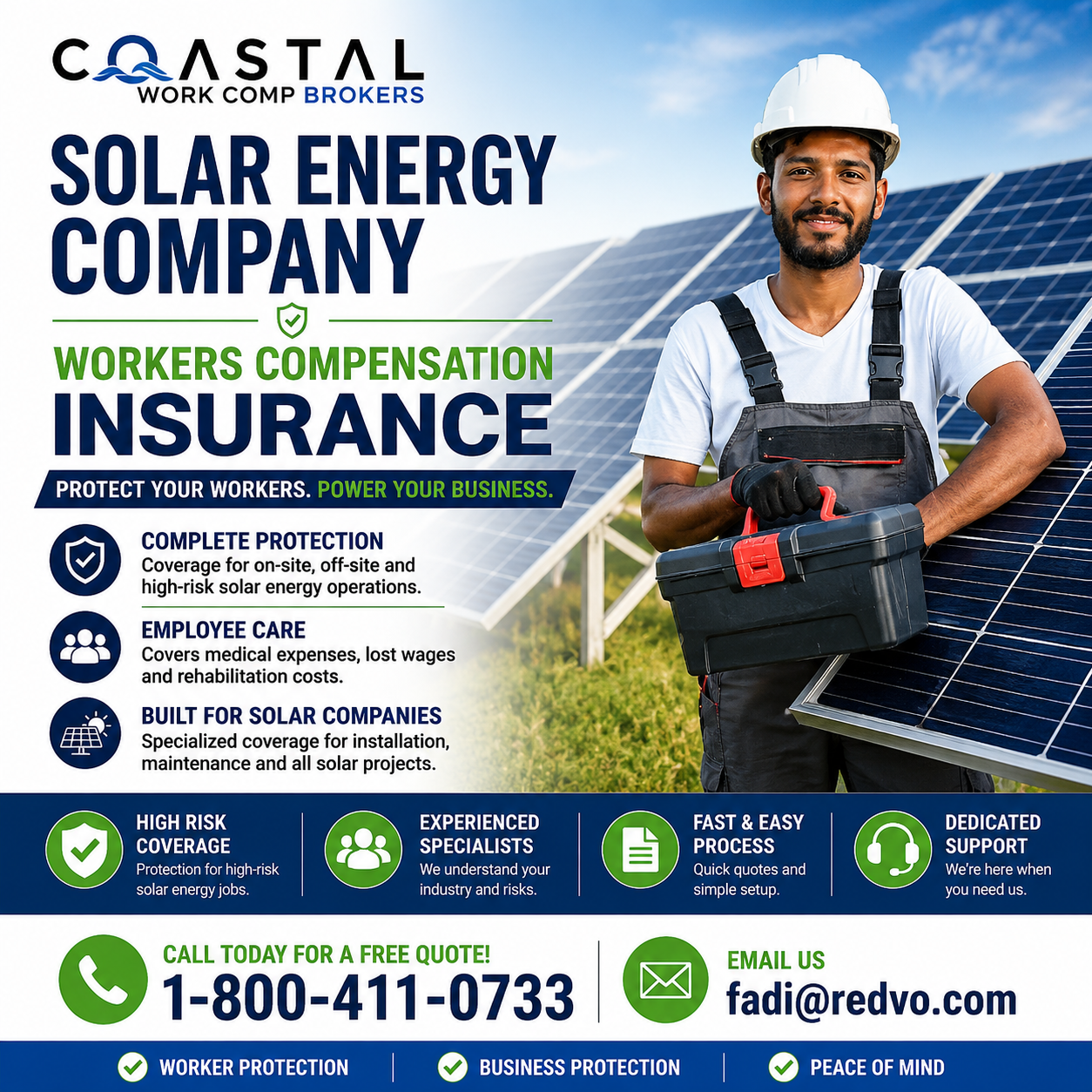
The solar energy industry is booming. As businesses and homeowners rush to harness the power of the sun, solar installation companies are scaling up their operations at a rapid pace. While the focus is often on renewable energy and sustainability, there is a less glamorous but absolutely critical aspect of running a successful solar business: protecting your workforce.
Installing solar panels is not a desk job. It involves heights, heavy equipment, electrical wiring, and extreme weather conditions. Without the right safety net, a single accident on a rooftop could financially cripple your company. This is where Solar Energy Company Workers’ Compensation Insurance becomes not just a legal requirement, but a fundamental pillar of your business strategy.
The Unique Risks of the Solar Industry
Unlike standard construction or general labor, solar installation carries specific hazards that require specialized insurance attention. Your employees are often working at significant heights, maneuvering heavy glass panels that can shatter, and dealing with high-voltage electrical systems. According to the Occupational Safety and Health Administration (OSHA), falls are the leading cause of death in the construction industry, and solar workers are particularly vulnerable.
Workers’ compensation is designed to cover medical expenses and a portion of lost wages if an employee is injured on the job. However, in the solar sector, the costs are often higher. A serious fall might not only require immediate emergency care but also long-term rehabilitation. Without adequate coverage, these costs come directly out of your pocket, potentially putting your business out of operation.
Beyond Legal Compliance
Currently, 49 states require businesses with employees to carry workers’ compensation insurance. Failing to do so can result in hefty fines, legal penalties, and even the suspension of your business license. For a solar company, maintaining a clean safety record is also crucial for winning bids. Commercial clients and general contractors will often verify your insurance certificates before allowing you on their property.
But beyond compliance, providing this insurance demonstrates that you value your team. In a tight labor market, skilled solar installers are hard to find. Offering robust benefits, including comprehensive workers’ comp for roofers and installers, helps with employee retention. Workers are more likely to stay loyal to a company that prioritizes their health and safety.
How Premiums Are Calculated
Insurance providers determine your premium based on several factors. The primary driver is your classification code. Solar installers generally fall under a specific code that accounts for the physical nature of the work. Your payroll is another significant factor; the higher your payroll, the higher the exposure, and thus, the higher the premium.
However, the most controllable factor is your claims history. A company with a high frequency of claims will see its rates skyrocket. This is why safety training is an investment, not an expense. Implementing rigorous safety protocols, providing high-quality personal protective equipment (PPE), and conducting daily safety briefings can drastically reduce incidents.
The Cost of Going Bare
Some business owners look at the premium for workers’ compensation for electricians and consider “going bare”—skipping insurance to save money. This is a catastrophic risk. If an employee is injured and you are uninsured, you are not only liable for medical bills but also subject to “Stop Work” orders from state authorities.
Moreover, you open yourself up to civil lawsuits. Without the exclusive remedy provision of workers’ comp, an injured worker can sue your company for negligence. Legal defense costs alone can bankrupt a small business, even if you win the case.
Tailoring Coverage to Your Needs
As a solar energy company, you need a policy that covers all aspects of your operations. This includes employees working in the office, those on the roof, and those driving between job sites. Many insurers offer packages that bundle general liability for solar companies with workers’ comp, providing a comprehensive safety net.
It is essential to work with an agency that understands the renewable energy sector. They can help you implement a return-to-work program, which helps lower your experience modification factor (MOD) by getting injured employees back to work in light-duty roles faster.


