

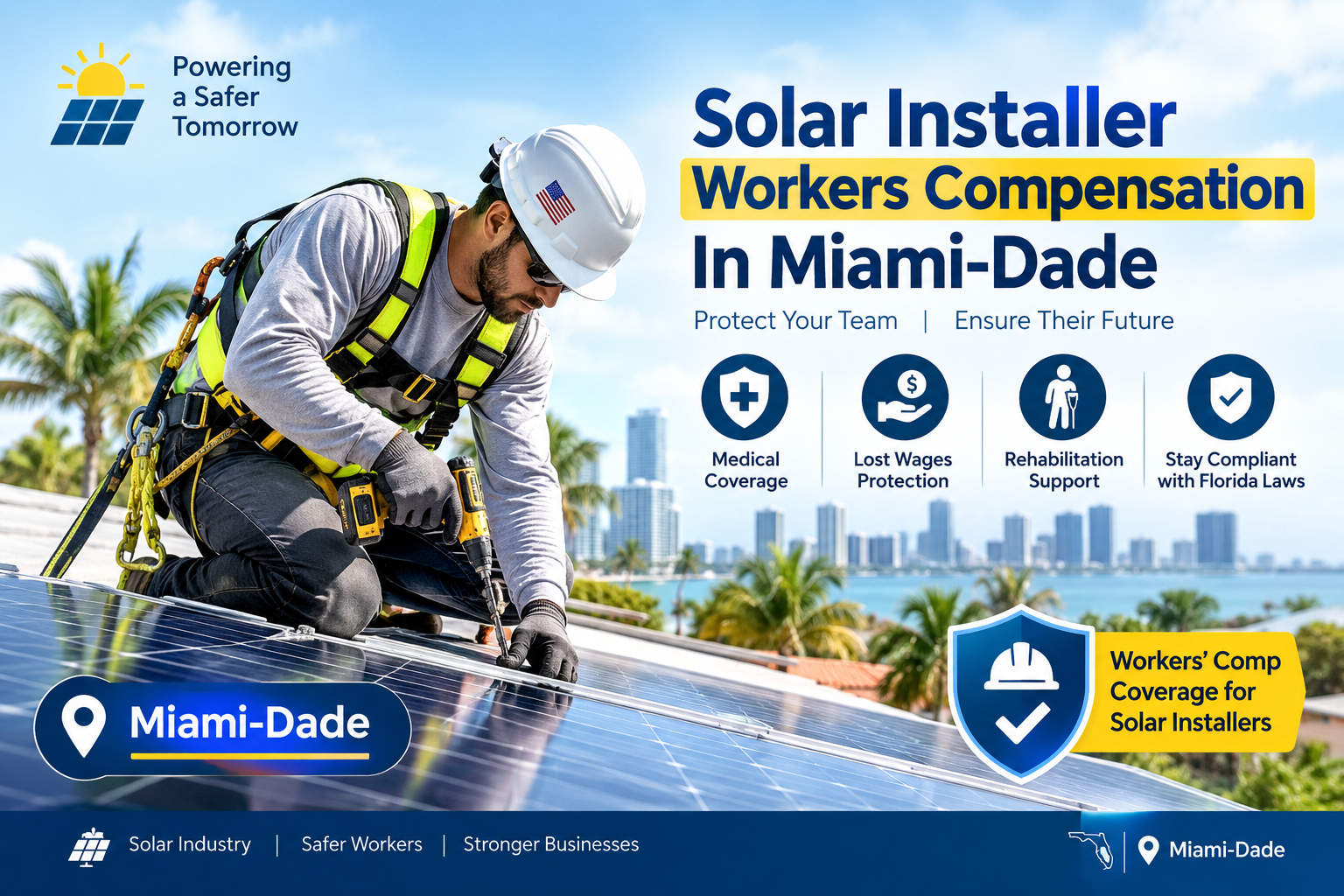
Miami, Hialeah and Homestead sit in the High Velocity Hurricane Zone, which has some of the strictest building rules in the country for roofs and rooftop equipment. Coastal Work Comp helps solar installers and contractors in Miami-Dade County set up workers’ compensation coverage that matches the work their crews actually do. Call 1-800-411-0733 to talk with our team.
Solar installation work in Miami-Dade County, Florida
Racking and attachments must meet HVHZ product approval rules, and many jobs are on flat or tile roofs of homes and mid-rise buildings.
Common injury risks for solar crews in Miami-Dade County
Year-round heat, hurricane season and dense urban job sites are the main risks. The risks we see most often for solar businesses here include:
- Storm-damage repair and re-roof work after hurricanes
- Wind uplift when panels are carried across a roof
- Lightning from afternoon thunderstorms
- Heat exhaustion and heat stroke on dark or metal roofs
- Hoisting panels onto mid-rise roofs
- Falls from roofs, ladders and lifts
- Electrical shock and arc flash while wiring inverters and panels
- Back and shoulder strains from lifting panels
Florida workers’ compensation rules for solar contractors
Florida treats solar installation as construction work. Construction employers must carry workers’ compensation if they have even one employee, and that count includes owners and corporate officers unless they hold an approved officer exemption (up to three officers can be exempt).
The Division of Workers’ Compensation runs active compliance checks on job sites. A solar company found without coverage can receive a stop-work order on the spot and a penalty based on twice the premium it should have paid over the past two years.
Claims and disputes in Florida are handled by the Florida Division of Workers’ Compensation. If an employee is hurt on the job, report the injury to your carrier quickly and keep notes on what happened, who saw it and what treatment was given.
Weather and job-site safety in Florida
Florida combines high heat with high humidity, which makes heat stress more likely than the thermometer alone suggests. Afternoon thunderstorms also bring lightning, and crews should come off roofs when storms move in.
Employees, subcontractors and 1099 installers
In Florida, a contractor is responsible for the workers of any uninsured subcontractor on its project. If your sub’s installer is hurt and the sub has no policy, the claim can land on your policy, so check every subcontractor’s coverage or exemption before they step on a roof.
Many solar companies use a mix of their own crews and outside electricians or roofers. Write down who does what on each job, keep current certificates on file, and tell your carrier about any subcontracted work so it is handled correctly at audit time. If you want to avoid a large year-end audit bill, ask us about pay-as-you-go workers’ comp, which bills premium from actual payroll each pay period.
For more on statewide rules, see our guide to solar workers’ comp in Florida.
How solar workers’ comp premiums are set
Premium is based on three main things: the class codes that describe each employee’s job, the payroll in each class, and your company’s experience modification factor (EMR), which reflects past claims. Installers who work on roofs are usually rated very differently from warehouse staff, sales reps or office employees, so splitting payroll correctly between classes can make a large difference in cost.
Good safety habits lower costs over time. A written fall protection plan, documented training, regular ladder and harness checks, and a return-to-work program all help keep claims small and your EMR down.
How to get a quote
Coastal Work Comp works with A-rated carriers that write solar and other high-risk contractors, including companies with past claims, a high EMR or a gap in coverage. Have your payroll by job type, a short description of your work and your past three years of loss history ready. You can read more on our solar installer workers’ comp insurance page or contact us for a quote. Call 1-800-411-0733.
Frequently asked questions
Do solar installers in Miami-Dade County need workers’ comp?
Yes. Solar installation is construction work in Florida, so coverage is required with even one employee, unless officers hold an approved exemption.
Does workers’ comp cover rooftop falls?
Yes. Work-related injuries to covered employees, including falls from roofs and ladders, are generally covered. Benefits can include medical care and partial wage replacement while the worker recovers, as set by state law.
How fast can I get a certificate of insurance?
Once a policy is bound, a certificate can often be issued the same day, so you can send it to a homeowner, utility or general contractor before the job starts. Call 1-800-411-0733 to start.


